
Best Email Capture Service: 5 Tools Compared
Traffic is valuable only when a meaningful percentage of visitors become contacts you can reach again.
A reader may enjoy an article, compare products, or visit a landing page, but without an email address, the relationship often ends when the browser tab closes.
That is why choosing the best email capture service requires more than finding the cheapest form builder.
The five platforms below solve different conversion problems.
QuickSum AI turns existing blog and YouTube content into AI-powered lead magnets, while LeadCapture focuses on verified leads and routing.
Convertful and OptinMonster specialize in website widgets and behavior-based campaigns, and Heyflow builds interactive qualification funnels.
We compare capture formats, targeting, lead quality, integrations, analytics, pricing, ease of use, and ideal users.
Recommendations are based on the supplied product capabilities and pricing information, so check current plan terms before purchasing.
What Is the Best Email Capture Service?
Here are our team's top picks for the best email capture service:
| Service | Best for |
|---|---|
| QuickSum AI | Content-specific AI lead magnets |
| LeadCapture | Verified leads and lead routing |
| Convertful | Affordable gamified website opt-ins |
| Heyflow | Mobile-first interactive funnels |
| OptinMonster | Behavior-targeted popup campaigns |
1. QuickSum AI
best for content-specific AI lead magnets.
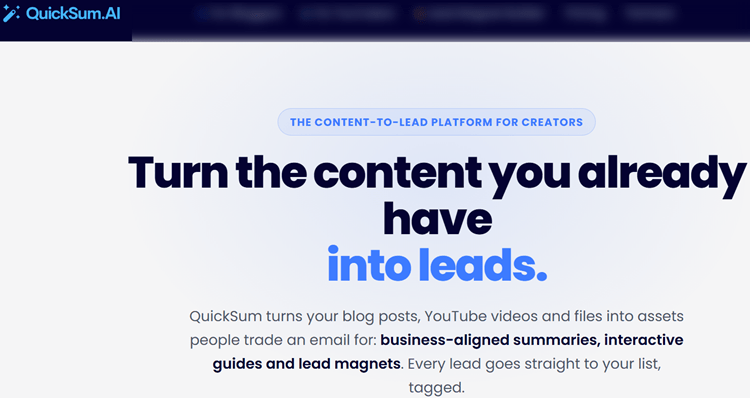
QuickSum AI is designed for publishers and creators who already have valuable long-form content but struggle to convert readers into subscribers.
Instead of offering a generic discount or newsletter prompt, it offers an article-specific AI summary in exchange for an email address.
It can also turn YouTube content into video guides, giving creators a second path for capturing leads.
Key Features:
- AI-generated summaries for individual blog posts.
- AI video guides created from YouTube content.
- Exit-intent, scroll-rate, time-on-page, and page-level triggers.
- Lightweight widgets for WordPress, Wix, Squarespace, Webflow, Ghost, and HTML sites.
- Integrations with Mailchimp, ActiveCampaign, HubSpot, Kit, beehiiv, Brevo, and other ESPs and CRMs.
- Per-post conversion analytics, email engagement tracking, UTM attribution, and multi-variant testing.
- Review-and-approve workflow with caching to reduce repeated AI generation costs.
User Experience:
The setup is relatively straightforward.
A publisher connects a content platform, adds the widget, reviews the generated summaries, and connects an email or CRM account.
The product is especially interesting as an automated lead magnet because it repurposes assets the business has already created rather than requiring a new ebook, checklist, or course for every campaign.
Pricing:
Pricing starts at $99 per month on the early-bird monthly plan, normally $124, or $797 for early-bird lifetime access, normally $997.
Both plans include a 30-day free trial, unlimited lead captures, one website or domain, one YouTube channel, five AI-powered widgets, and up to 25,000 embed page views per month.
Users must bring a Claude or GPT API key, an ESP or CRM key, and SendGrid or Resend for delivery, which creates additional costs but keeps usage more transparent.
Pros:
- Offers immediate, content-relevant value instead of a generic popup.
- Supports blog and YouTube lead generation in one platform.
- Includes unlimited lead captures on the listed plans.
- Provides content-level analytics and approval control.
Cons:
- Works best for sites with established traffic and substantial content.
Best for:
Bloggers, YouTubers, affiliates, digital publishers, and online businesses with long-form content.
Expert Opinion:
QuickSum AI is the most differentiated product in this comparison because its conversion offer is tied directly to what the visitor is reading or watching.
It is not a universal replacement for popups or CRM software, but it is a compelling choice when the main goal is to monetize existing content without creating a new lead magnet from scratch.
Get started with QuickSum AI.
2. LeadCapture
best for verified leads and lead routing.

LeadCapture is built for businesses that care about lead quality, routing, and downstream revenue rather than simply increasing subscriber counts.
It combines landing pages, forms, quizzes, surveys, and multi-step funnels with real-time email and phone verification, enrichment, contact scoring, compliance tools, and conversion tracking.
Key Features;
- AI-assisted landing page, funnel, quiz, and form creation.
- Real-time email and phone verification.
- Contact scores based on validity, completion, and engagement signals.
- Data enrichment, click-fraud detection, and partial lead capture.
- TCPA-oriented workflows using TrustedForm and Jornaya.
- Tracking for Meta, Google Ads, GA4, Google Tag Manager, Everflow, and webhooks.
- Routing integrations including LeadProsper, LeadByte, Phonexa, HighLevel, Zapier, and more.
User Experience:
The interface is aimed at performance marketers and agencies, so it may feel more operational than a basic newsletter tool.
Its value becomes clearer when a captured lead must be scored, sent to a buyer, synchronized with a CRM, or supported by consent evidence.
That makes it one of the strongest lead capture tools for regulated or high-value verticals.
Pricing:
The Starter plan costs $199 monthly or $159 per month billed annually and supports up to 1,000 leads.
Core costs $399 monthly or $319 annually with up to 10,000 leads, while Scale costs $699 monthly or $559 annually with up to 25,000 leads.
Enterprise pricing is customized.
Plans include a seven-day free trial and a 60-day money-back guarantee, with no overage charges within the stated lead allowance.
Pros:
- Verification, enrichment, scoring, and routing are built into one platform.
- Strong compliance and fraud-detection capabilities.
- Useful conversion tracking for paid acquisition.
- Suitable for agencies and lead buyers.
Cons:
- Expensive for a small blog or basic newsletter.
Best for:
Lead-generation agencies, performance marketers, and insurance, mortgage, solar, legal, and home-service businesses.
Expert Opinion:
LeadCapture is the right choice when a “lead” must be usable, compliant, and deliverable to another system.
It is not the most economical email-list builder, but its verification and routing features can justify the price when poor-quality leads directly affect revenue.
Get started with LeadCapture.
3. Convertful
best for affordable gamified website opt-ins.

Convertful focuses on flexible onsite engagement at a relatively accessible price.
It supports popups, floating bars, inline forms, scroll boxes, welcome mats, quizzes, surveys, spin-to-win campaigns, scratch cards, and other interactive widgets.
This broad format selection makes it useful for marketers who want to experiment beyond a standard embedded form.
Key Features:
- Drag-and-drop builder with templates and mobile-friendly designs.
- Exit-intent, scroll, time, page, geographic, and other display rules.
- Multi-step forms, content locking, dynamic text, countdowns, and gamification.
- A/B testing, widget-flow optimization, live analytics, and retargeting pixels.
- Native email and CRM integrations plus Zapier.
- Two-way CRM synchronization on qualifying plans.
User Experience:
The user experience is no-code and practical, making Convertful accessible to small teams.
It can be installed on WordPress or any site that accepts a connection script, and Google Tag Manager is available for easier deployment.
Its gamified campaigns may work particularly well for ecommerce brands offering discounts, giveaways, or product recommendations.
Pricing:
The Solo plan costs $9 monthly or $7 per month annually and supports one site and 10,000 pageviews.
Starter begins at $29 monthly or $17 annually, Growth at $69 monthly or $47 annually, and Enterprise at $179 monthly or $97 annually.
All plans include a 14-day free trial, but pageview limits matter: once the limit is reached, widgets may stop displaying until the quota resets or the account is upgraded.
Pros:
- Wide range of widget and gamification formats.
- Affordable entry-level pricing.
- No-code editor and useful templates.
- Strong targeting and CRM synchronization on higher plans.
Cons:
- Pageview limits can interrupt campaign delivery.
Best for:
Small websites, bloggers, ecommerce brands, and budget-conscious marketers.
Expert Opinion:
Convertful offers one of the best feature-to-price ratios for onsite opt-ins.
It is particularly attractive when you want quizzes, spin-to-win campaigns, and flexible display rules without adopting a larger marketing platform.
Get started with Convertful.
4. Heyflow
best for mobile-first interactive qualification funnels.

Heyflow is built around interactive, multi-step experiences rather than isolated signup forms.
Businesses can use it for quizzes, applications, appointment funnels, post-click landing pages, payments, and qualification journeys.
Conditional logic lets the flow change based on each visitor’s responses.
Key Features:
- Mobile-first builder with more than 40 blocks.
- Conditional logic, AI-generated blocks, payments, and qualification steps.
- Native CRM connections, analytics, tracking, webhooks, and server-side ad tracking.
- Phone validation, SMS OTP, and partial submission capture.
- A/B testing and page- or session-level insights.
- Integrations with HubSpot, Salesforce, Pipedrive, Zoho, HighLevel, Mailchimp, ActiveCampaign, Slack, Twilio, and Calendly.
User Experience:
Heyflow’s interface is designed to help non-technical teams build polished experiences quickly.
Its mobile performance is a significant advantage for paid traffic, where visitors often arrive on phones and abandon slow or cluttered pages.
It is also useful when collecting an email address is only one step in a longer qualification process.
Pricing:
Starter costs $89 monthly or $49 per month annually and includes 50 responses per month.
Growth costs $149 monthly or $99 annually with 250 responses, while Scale costs $299 monthly or $249 annually with 1,000 responses.
Enterprise starts at $1,100 per month.
A 14-day free trial is available, although additional seats, funnels, responses, feature bundles, and AI credits can increase the final cost.
Pros:
- Excellent mobile-first interactive experiences.
- Powerful conditional logic and qualification features.
- Supports payments, validation, and partial submissions.
- Strong CRM, advertising, and webhook connectivity.
Cons:
- More expensive and complex than a simple signup form.
- Response quotas and add-on bundles require careful planning.
Best for:
Businesses using quizzes, applications, appointments, calculators, or post-click funnels.
Expert Opinion:
Heyflow is a strong option when the conversion journey needs to feel guided and personalized.
For a basic newsletter, it is probably excessive, but for paid campaigns and qualification-heavy workflows, its mobile experience and conditional logic are valuable.
Get started with Heyflow.
5. OptinMonster
best for behavior-targeted popup campaigns.

OptinMonster is a mature onsite conversion platform focused on showing the right campaign at the right moment.
It supports popups, floating bars, slide-ins, fullscreen campaigns, inline forms, welcome mats, and gamified campaigns, with detailed rules for visitor behavior and context.
Key Features:
- Large template library and no-code campaign editor.
- Exit intent, scroll, time-on-site, device, referral, geographic, cart, and returning-visitor targeting.
- Content locking, countdown timers, Smart Tags, scheduling, and click-to-load campaigns.
- A/B testing, analytics, revenue attribution, webhooks, and Zapier.
- Broad ESP and CRM integrations.
- Ecommerce targeting for platforms such as Shopify and WooCommerce on higher plans.
User Experience:
The platform is especially useful for businesses that already have meaningful traffic but are losing visitors before subscription or purchase.
Its targeting controls help reduce the “same popup for everyone” problem by adapting campaigns to source, device, visit history, and onsite behavior.
Pricing:
Basic starts at $7 per month billed annually and includes 2,500 campaign impressions.
Plus costs $19, Pro $29, and Growth $49 per month annually.
Exit intent and revenue attribution begin on Pro, while advanced ecommerce targeting is included with Growth.
OptinMonster provides a 14-day money-back guarantee, and impression limits vary by plan.
Pros:
- Sophisticated behavioral targeting and personalization.
- Broad selection of campaign formats.
- Useful testing and revenue-attribution tools.
- Strong fit for bloggers, ecommerce stores, and agencies.
Cons:
- Impression limits require monitoring.
Best for:
Businesses with existing website traffic that need targeted popups and onsite campaigns.
Expert Opinion:
OptinMonster remains one of the strongest choices for campaign targeting and exit-intent optimization.
It works best when you already know which pages and visitor segments deserve a tailored offer.
Get started with OptinMonster.
Which Email Capture Service Is Right for You?

Choose QuickSum AI if your blog or YouTube channel is the primary source of leads and you want a content-specific offer.
It is particularly compelling for publishers exploring a content repurposing strategy for subscriber growth.
Choose LeadCapture when lead verification, enrichment, compliance, scoring, routing, or buyer delivery is essential.
Choose Convertful when you want affordable widgets, quizzes, surveys, and gamification.
Choose Heyflow when interactive qualification is central to the conversion process.
OptinMonster is the best fit for behavior-targeted popup campaigns, exit intent, testing, and revenue attribution.
Do not compare only the advertised starting price.
Check traffic or lead limits, integrations, required API keys, email delivery, add-ons, contact tiers, onboarding, and annual commitments before deciding.
How to Choose an Email Capture Service
Start with the capture format that matches the visitor’s intent.
Inline forms work well when the offer naturally belongs inside an article, while popups and floating bars can reach visitors at carefully selected moments.
Quizzes, surveys, landing pages, and multi-step funnels are better when you need to collect more information or qualify a prospect before sending them to sales.
Next, consider your audience and business model.
A blogger may only need a simple content upgrade, while an ecommerce company may need cart targeting and coupon campaigns.
Agencies often need multiple sites, sub-accounts, white-label controls, or lead routing.
Larger marketing teams may prioritize CRM history, workflows, attribution, and governance over a low monthly price.
Targeting also affects conversion quality.
Look for rules based on exit intent, scroll depth, time on page, referral source, device, location, page category, cart activity, and returning visitors.
More precise targeting can reduce interruption because the right offer appears to the right visitor rather than showing the same form to everyone.
Lead quality matters when contacts have commercial value.
Email and phone validation, enrichment, scoring, consent records, fraud detection, and partial submissions can help sales teams avoid wasting time.
If you only want newsletter subscribers, these features may be unnecessary; if you sell leads or operate in insurance, mortgage, solar, legal, or home services, they may be essential.
Finally, examine ownership and total cost.
Confirm that the platform connects to your email service provider or CRM, supports webhooks or exports, and preserves source data.
Include pageview limits, lead quotas, contact tiers, AI credits, API fees, email delivery, add-ons, onboarding, and annual commitments in your calculation.
FAQ
What is an email capture service?
An email capture service is software that collects visitor contact details through forms, widgets, popups, landing pages, quizzes, funnels, or content-based offers.
It usually sends those details to an email service provider or CRM, although some platforms can store leads temporarily or manage follow-up workflows themselves.
The capture tool creates the conversion experience; the ESP or CRM generally stores, segments, and nurtures subscribers.
What is the best service for a blog?
QuickSum AI is the strongest fit for publishers offering article-specific summaries or YouTube video guides.
Convertful and OptinMonster are better choices for conventional inline forms, popups, floating bars, gamification, and behavioral targeting.
The right option depends on whether your primary offer is content value or a more traditional signup incentive.
Which option is best for qualified leads rather than newsletter subscribers?
LeadCapture is the clearest choice because it supports verification, enrichment, scoring, compliance, fraud detection, and routing.
Heyflow is also useful when qualification requires an interactive funnel with conditional logic, phone validation, appointments, or partial submissions.
Both are more suited to sales workflows than simple newsletter growth.
Can I use these tools with my existing email platform?
Yes, all five provide integrations or connection methods, but capabilities differ.
QuickSum AI connects with major ESPs and CRMs and supports webhooks, while Convertful and OptinMonster offer broad email-platform integrations.
LeadCapture and Heyflow are designed for CRM, advertising, and routing workflows.
Before purchasing, verify support for your specific ESP, CRM, webhook format, analytics platform, consent workflow, and source-tagging requirements.
You should also confirm whether the integration is native or requires Zapier, custom code, or an additional subscription.
Conclusion: Match the Tool to the Conversion Job
There is no universal winner because email capture can mean several different things.
QuickSum AI is the standout for content-led publishers and creators who want to turn existing articles and videos into useful, personalized opt-in assets.
Convertful is the practical budget choice for flexible widgets and gamified campaigns, while OptinMonster is better for sophisticated popup targeting and onsite attribution.
Heyflow is the stronger option for mobile-first interactive funnels, qualification, applications, and appointments.
LeadCapture is the right fit when verification, compliance, enrichment, and lead routing matter more than low-cost list growth.
Start with the service that matches your existing traffic source, desired lead quality, and required workflow.
Use the available trial or guarantee to test real conversion performance, integration reliability, and total cost before making a long-term commitment.
Ready to improve your subscriber growth?
Test the platform that best matches your conversion job, measure qualified opt-ins—not just form submissions—and build from there.


