
Best Lead Magnet Generator: 5 Best Tools for More Leads
Choose a Lead Magnet Tool That Converts
Most website visitors leave without subscribing, even when they find the content useful.
That is why the best lead magnet generator should do more than place an email form on a page—it should deliver timely value, create a low-friction opt-in experience, and move new contacts into the email system you already use.
This roundup compares five tools for bloggers, YouTube creators, ecommerce brands, marketers, small businesses, and growing teams.
The products are not identical: some create content-based lead magnets, some improve popup conversion rates, others build interactive qualification funnels, and one provides a complete CRM-connected marketing platform.
We evaluated each option according to lead magnet creation or delivery, conversion features, integrations, automation, analytics, ease of setup, pricing, and scalability.
We also considered whether each platform supports an automated lead magnet workflow that gives visitors a relevant reason to subscribe instead of simply asking for their details.
The right choice depends on your audience, existing content, traffic volume, marketing stack, and desired outcome.
Below, you will find the strongest option for content-based AI lead magnets, gamified campaigns, qualification funnels, behavioral popup optimization, and CRM-connected lead management.
What Is the Best Lead Magnet Generator?
Here are our team’s top picks for the best lead magnet generator:
| Tool | Best for | Lead magnet approach |
|---|---|---|
| QuickSum AI | Bloggers and YouTube creators | AI summaries and video guides |
| Convertful | Small businesses and marketers | Popups, forms, quizzes, surveys, and gamification |
| Heyflow | Interactive lead funnels | AI-assisted forms and conversion flows |
| OptinMonster | Website conversion optimization | Popups, floating bars, slide-ins, and content locks |
| HubSpot | Businesses needing an all-in-one platform | Forms, landing pages, email, CRM, and automation |
The 5 Best Lead Magnet Generators Compared
1. QuickSum AI
Best for Content-Based AI Lead Magnets.
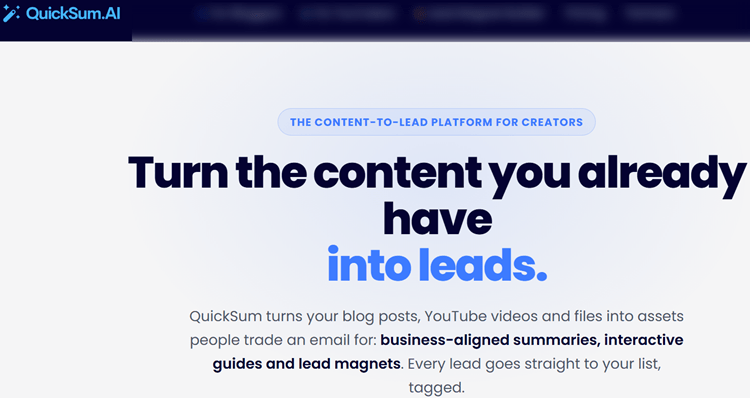
QuickSum AI turns existing blog posts and YouTube videos into article-specific summaries and video guides.
Instead of asking visitors to download a generic ebook, it offers immediate value based on the content they are already consuming.
The workflow is straightforward: add a lightweight widget to a blog or connect a YouTube channel, allow the AI to generate a summary, review or adjust it, and collect the visitor’s email address.
The approved resource is then delivered through the connected CRM or email platform.
Key Features include:
- Content-specific AI summaries rather than generic downloadable assets.
- AI-generated video guides for YouTube content.
- Exit-intent, scroll-rate, time-on-page, and page-level targeting.
- Automated summary emails, UTM preservation, affiliate tags, and smart tags.
- Integrations with Mailchimp, ActiveCampaign, HubSpot, Kit, beehiiv, Brevo, and other ESPs.
- Per-post conversion analytics, email performance tracking, and traffic attribution.
- Smart caching designed to reduce repeated AI-generation costs.
User Experience:
The setup is designed for nontechnical users and supports WordPress, Wix, Squarespace, Webflow, Ghost, and custom HTML.
You can install it with scripts or Google Tag Manager, while YouTube guides are managed through the QuickSum dashboard.
Pricing:
Pricing is listed at $99 per month during the early-bird offer or $797 for lifetime access.
Both plans include a 30-day free trial at launch, although users may need a Claude or GPT API key, a CRM connection, and a SendGrid or Resend account.
Those requirements make an email sender service an important part of the total cost calculation.
Pros:
- Converts existing articles and videos into relevant lead magnets.
- Creates a natural opt-in moment for busy readers and viewers.
- Includes blog and YouTube workflows in one platform.
- Offers unlimited lead captures within listed plan limits.
Cons:
- Requires existing content and established traffic to perform well.
Best For:
Bloggers, digital publishers, affiliate sites, educators, and YouTube creators with useful long-form content.
Expert Opinion:
QuickSum AI is the most differentiated option in this roundup because it creates and delivers content-specific value rather than simply changing the appearance of an opt-in form.
It is less suitable for a brand starting without content, but it can be highly efficient for publishers that want to monetize existing traffic without designing a separate course, checklist, or ebook.
Get started with QuickSum AI.
2. Convertful
Best for Gamified Lead Capture Campaigns.

Convertful is a flexible widget platform for building popups, floating bars, inline forms, welcome mats, scroll boxes, quizzes, surveys, coupon campaigns, scratch cards, and spin-to-win experiences.
Its strength is engagement: visitors can interact with the offer instead of seeing a static form.
The drag-and-drop builder supports mobile-friendly campaigns and works across major website platforms.
Marketers can combine multi-step widgets, content locking, dynamic text, countdown timers, and personalization to create more compelling opt-in experiences.
Key Features include:
- Exit-intent, device, page, and advanced targeting rules.
- Quizzes, surveys, scratch cards, coupon wheels, and gamification.
- A/B testing and widget-flow optimization.
- Two-way CRM synchronization, webhooks, Zapier, and native integrations.
- Live analytics, retargeting pixels, and agency sub-accounts on higher plans.
- Mobile-friendly templates and no-code campaign editing.
User Experience:
Convertful is particularly useful when the incentive is a discount, personalized recommendation, contest, or quiz result.
Its interface is built for marketers rather than developers, although more advanced campaigns may require careful planning to avoid overwhelming visitors.
Pricing:
Plans start at approximately $9 per month when billed monthly or $7 per month with annual billing for the Solo tier.
Higher plans increase site, pageview, integration, and agency capacity, and a 14-day free trial is available.
Pageview limits should be monitored because campaigns may stop displaying after a plan threshold is reached.
Pros:
- Strong range of interactive and gamified formats.
- Useful targeting and personalization controls.
- Suitable for small businesses and ecommerce teams.
- Works without coding on many website platforms.
Cons:
- Advanced features require higher plans.
Best For:
Small businesses, ecommerce brands, bloggers, and marketers searching for flexible email capture service with quizzes, incentives, and gamification.
Expert Opinion:
Convertful is a strong choice when visitor participation is central to the campaign.
It is not intended to generate the underlying ebook or educational resource, but it can make the delivery and opt-in experience considerably more engaging.
Get started with Convertful.
3. Heyflow
Best for Lead Qualification Funnels.

Heyflow creates interactive, multi-step flows for businesses that need more than an email address.
You can build forms, quizzes, calculators, applications, booking journeys, payment flows, and recommendation funnels with conditional logic.
Its AI-assisted builder can generate blocks and help users create a starting structure.
From there, teams can customize branding, questions, routing rules, validation, and integrations to create a guided experience for each visitor.
Key Features include:
- AI-generated blocks and AI-assisted funnel creation.
- Conditional logic, mobile-first layouts, and customizable branding.
- Native CRM integrations, webhooks, analytics, and tracking.
- Phone validation, SMS OTP, partial submissions, and lead qualification.
- A/B testing and advanced tracking on higher plans.
- Payments through Stripe or Solidgate.
User Experience:
The platform is especially useful for agencies, service businesses, recruiters, real estate teams, and companies offering estimates or appointments.
Instead of sending every contact to the same destination, Heyflow can segment and route leads based on their answers.
Pricing:
Annual plans start at approximately $49 per month, while monthly plans start at approximately $89 per month.
Plans are based on responses, funnels, seats, and feature bundles, with a free trial available without a credit card.
Costs can rise as response volume and advanced requirements increase.
Pros:
- Excellent for conversational and qualification-heavy journeys.
- Captures more useful data than a standard form.
- Supports sales, recruiting, appointments, ecommerce, and services.
- Offers more than 50 direct integrations and workflow connections.
Cons:
- Some advanced features require higher plans or add-ons.
Best For:
Businesses looking for interactive lead capture tools that qualify, segment, route, or book prospects.
Expert Opinion:
Heyflow is not a conventional lead magnet generator; it is a conversion funnel platform.
Choose it when the lead magnet is a calculator, assessment, application, or recommendation flow, rather than a simple PDF or newsletter signup.
Get started with Heyflow.
4. OptinMonster
Best for Behavioral Popup Optimization.

OptinMonster helps websites convert existing traffic through popups, floating bars, slide-ins, fullscreen campaigns, inline forms, content locks, coupon wheels, and exit-intent offers.
Its focus is not creating the resource itself but presenting the right offer to the right visitor at the right moment.
The no-code builder includes a large template library and targeting rules for exit intent, scrolling, time on site, pages, devices, referrals, geolocation, and returning visitors.
These controls can turn a generic campaign into a context-aware offer that reflects the visitor’s behavior.
Key Features include:
- Hundreds of templates and a no-code campaign builder.
- Exit intent, scroll, referral, geolocation, and returning-visitor targeting.
- A/B testing, smart tags, scheduling, and follow-up campaigns.
- Revenue attribution and ecommerce integrations on higher plans.
- Integrations with email platforms, CRMs, Zapier, webhooks, and analytics tools.
User Experience:
OptinMonster is relatively easy to deploy and works with platforms such as WordPress, Shopify, Squarespace, and Wix.
However, marketers need to use frequency controls and thoughtful timing because excessive popups can damage the user experience.
Pricing:
The Basic plan is listed from $7 per month when billed annually, with higher tiers based on campaign impressions, sites, and features.
A 14-day money-back guarantee is available.
Businesses should compare expected traffic with impression limits before selecting a tier.
Pros:
- Mature behavioral targeting and personalization.
- Strong fit for exit-intent and cart-recovery campaigns.
- Large template library and straightforward builder.
- Higher plans connect campaigns to revenue.
Cons:
- Impression and site limits vary by plan.
Best For:
Websites that already have lead magnets and need better behavior-based popup campaigns, timing, testing, and conversion attribution.
Expert Opinion:
OptinMonster remains one of the strongest choices for onsite conversion optimization.
It complements QuickSum AI, Convertful, or an existing content offer rather than replacing the process of creating a valuable resource.
Get started with OptinMonster.
5. HubSpot
Best for CRM-Connected Lead Management.

HubSpot combines forms, landing pages, email marketing, CRM records, automation, reporting, segmentation, live chat, and sales alignment.
It is the broadest platform in this comparison and is designed for businesses that want lead capture connected to the entire customer lifecycle.
The free CRM and free marketing tools allow smaller teams to begin without a software subscription.
As requirements grow, paid plans add more contacts, automation, reporting, behavioral event triggers, revenue attribution, AI-powered agents, social media tools, AEO, and omni-channel workflows.
Key Features include:
- Forms, landing pages, email campaigns, live chat, and downloadable offers.
- Contact segmentation, CRM records, and basic automation.
- Campaign reporting, behavioral triggers, and revenue attribution on advanced plans.
- AI agents, marketing studio, social media, and omni-channel automation.
- A broad ecosystem of native and third-party integrations.
User Experience:
HubSpot offers a polished experience for teams willing to invest in learning the platform.
It can reduce the number of disconnected tools in a marketing stack, but implementation becomes more involved as contacts, seats, workflows, and permissions increase.
Pricing:
Free tools are available, while Starter begins at approximately $7 per month per seat annually or $10 monthly.
Professional starts at approximately $800 per month annually and requires onboarding, while Enterprise starts at approximately $3,600 per month plus onboarding.
Pros:
- Connects lead capture, CRM, email, automation, and reporting.
- Strong option for complex customer journeys.
- Free tools provide a low-risk starting point.
- Advanced segmentation and attribution support mature teams.
Cons:
- Professional and Enterprise plans are expensive.
Best For:
Growing businesses that need CRM integration tools connecting lead magnets to sales, marketing automation, and customer reporting.
Expert Opinion:
HubSpot is best viewed as a complete marketing operating system rather than a standalone lead magnet generator.
It is powerful for teams with multiple campaigns and sales processes, but smaller organizations may achieve better value with a focused tool and an existing email platform.
Get started with HubSpot.
Category Breakdown: Which Tool Is Right for You?
The five platforms serve different jobs, so they should not be treated as interchangeable.
QuickSum AI creates and delivers content-specific summaries, while Convertful makes opt-ins interactive through quizzes, surveys, incentives, and gamification.
Heyflow is designed for guided qualification and routing, making it suitable for calculators, applications, bookings, and complex forms.
OptinMonster improves when and where offers appear, while HubSpot connects lead capture to CRM records, nurturing, reporting, and sales operations.
- Best for content-based AI lead magnets: QuickSum AI.
- Best for gamified lead capture campaigns: Convertful.
- Best for lead qualification funnels: Heyflow.
- Best for behavioral popup optimization: OptinMonster.
- Best for CRM-connected lead management: HubSpot Marketing Hub.
For permission, privacy, and email compliance considerations, review official guidance such as CAN-SPAM requirements for commercial email before launching campaigns.
The best-performing tool still needs clear consent, accurate expectations, and a useful follow-up experience.

How to Choose the Best Lead Magnet Generator
Before comparing individual platforms, identify what you want your lead magnet to do.
A content publisher may need an AI summary delivered after an article opt-in, while an ecommerce brand may want a discount wheel or quiz.
A service business may need a calculator that qualifies leads before sending them to sales.
Match the Tool to the Lead Magnet Format
Consider AI summaries and content upgrades if you already publish blog posts, tutorials, research, or YouTube videos.
Quizzes, surveys, calculators, and recommendation tools are better when the visitor needs a personalized result before submitting contact information.
Popups and inline forms work well when you already have a downloadable asset, coupon, checklist, or newsletter.
Multi-step funnels are more suitable for applications, bookings, estimates, payments, and other journeys that require qualification.
Landing pages, email sequences, and CRM workflows matter when lead capture is only the first step.
If you want to understand the broader market, a guide to modern AI lead generation platforms can help distinguish inbound content tools from outbound prospecting software.
Check Integration Requirements
Review compatibility with your email service provider, CRM, analytics platform, webhooks, Zapier, payment tools, and advertising accounts.
A tool can have impressive conversion features but still create manual work if leads cannot be routed automatically.
Also check whether integrations are included on your chosen plan.
Some platforms reserve webhooks, two-way synchronization, advanced tracking, or payment processing for higher tiers.
Evaluate Conversion Controls
The strongest tools let you control when and where an offer appears.
Useful options include exit intent, scroll depth, time-on-page, page-level targeting, device targeting, personalization, conditional logic, and A/B testing.
Do not optimize only for submission volume.
A campaign that generates many low-quality contacts may be less valuable than a smaller campaign that produces engaged subscribers, qualified sales opportunities, or revenue.
Review Total Cost
The advertised subscription is only one part of the budget.
Also account for pageview or impression limits, response quotas, AI credits, API keys, email delivery, contact tiers, seats, onboarding, and additional integrations.
For example, a BYOK platform may have a lower software cost but require your own AI provider and email sender.
Conversely, an all-in-one platform may cost more but reduce the number of separate systems your team must manage.
Prioritize Reporting and Ease of Setup
Look for reporting that covers opt-in rate, lead quality, source attribution, engagement, and revenue—not just form submissions.
Setup should also match your technical ability, whether that means a no-code builder, a website script, Google Tag Manager, or a native CMS plugin.
FAQ: Best Lead Magnet Generators
What is a lead magnet generator?
A lead magnet generator is a tool that helps create, deliver, or promote something valuable in exchange for contact information.
Depending on the platform, it may generate content, build forms, create interactive funnels, or automate follow-up.
Which tool is best for bloggers?
QuickSum AI is the strongest fit for bloggers with established long-form content because it turns articles into email-delivered summaries.
OptinMonster and Convertful are better choices when the main need is popup targeting, interactive forms, or gamification.
Can these tools work with an existing email platform?
Yes, all five support integrations, although the depth varies by product and plan.
Check compatibility with your specific CRM or ESP before subscribing, because some connections may require webhooks, Zapier, API keys, or a higher-tier subscription.
What should I avoid when choosing a lead magnet tool?
Avoid choosing based only on the lowest advertised price.
Check traffic, impression, response, contact, AI-credit, and email-delivery limits, along with setup requirements and the actual value your audience will receive after opting in.
Conclusion: Choosing the Right Tool for More Leads
The best lead magnet generator depends on the experience you want to create.
QuickSum AI is the standout choice for bloggers, publishers, affiliates, educators, and YouTube creators who want to turn existing content into relevant summaries and video guides with minimal production work.
Convertful is better for gamified campaigns, quizzes, surveys, coupons, and flexible widgets.
Heyflow is the stronger option for qualification-heavy and conversational funnels, while OptinMonster is ideal for sophisticated popup targeting, exit intent, and behavioral conversion optimization.
HubSpot is the most comprehensive choice for teams that want forms, landing pages, email, CRM management, automation, reporting, and sales alignment in one ecosystem.
Its advanced capabilities justify the cost for growing organizations, but they may be unnecessary for a solo creator.
Choose the platform that matches both your lead magnet format and your existing marketing stack.
Then test opt-in rate, lead quality, engagement, and downstream revenue—not just the number of form submissions.
Start by comparing the relevant trial or free plan, and use real traffic to determine which tool creates the most valuable subscriber growth for your business.


